


- Messages
- 70
- Classified ads
- 2
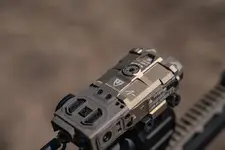
In a couple different places I've been asked to do a writeup on weapon-mounted laser rangefinders, so I decided to do it here and I'll just link people to this in the future when the question about them gets asked. As for systems I'm familiar with, I've now used a Fire4000, Impact 4000, very briefly one of the older Wilcox units, and I own a Maztech 2k. Aside from weight/form factor, these units are all designed to provide the same capability and are all used the same way, so there's honestly not much to say about each one individually. Yeah the lasers may be better/worse depending on price point, however I've experienced the same inability to range based on environmental conditions of all the ones I've personally had time behind, and I've had all of them give me accurate ranges out to practical distances so there's not much point in providing a single-unit review that a bit of Google-fu and numbers comparison will do for you.
However what I DO think provides value to some people is an overview of the capability these units provide, as well as some upsides and downsides that some people haven't considered yet. At their core, these things are trying to take three things and unitize them into one system with a module-based approach; the riflescope, laser rangefinder, and ballistic calculator. Now, it's been tried in the past to just produce a single riflescope that incorporated all these design elements, however this pretty much always ends up with serious compromises with one or more of those three aspects, and I've yet to see one that you could call a genuine commercial success as a result of that. By separating the laser/ballistic calculators into a standalone module, you gain the versatility of using whatever optic you want, with whatever reticle you want, and the amount of compromise in the resulting total system is not only kept to a minimum, but can be chosen by the shooter to fit their specific needs.
NEEDS
I would go out on a limb and argue that most shooters don't actually need one of these things at all, and are getting one due to a few reasons. One could be that they simply haven't considered the downsides to these units. Another could be that they saw one on their favorite GunTuber Larper's rifle and thought it was too cool for school. Or maybe it's a combination of both funded by a fresh tax return or motivated by everything being available with x number of payments like we saw before the 2008 collapse. Regardless, for most people who have first identified the legitimate need for laser rangefinding/ballistic calculator capabilities, a set of rangefinding binoculars are typically a much better idea. As an added bonus, now you also have a likely pretty nice pair of binoculars for vacation, birdwatching, or some good old peeping tom activities like Marty McFly. Never underestimate the benefits of magnified optics that don't happen to be attached to a rifle. Binos don't bring with them the inherent infastructure, bulk, or potential safety cosiderations that scopes mounted to rifles do, and Back to the Future would have been a very different movie if Marty fell out of that tree with a gun.
SCOPE
In order to use one of these to range a target, the laser needs to be aligned to the scope erector assembly in parallel (or as close as you can get to parallel). I've seen in the past where someone simply aligned their laser to the center of their scope reticle at 100yds and didn't stop to think that those two lines of sight not only converged at that point, but would then de-converge past that point in opposite directions. Additionally, because the laser needs to be aligned to the erector assembly, that means that dialing any elevation and/or windage disrupts the relationship between the scope and erector assembly, and you end up with a similar issue. This means one of two things; only holding your ballistic corrections, or remembering to dial back to zero between every subsequent ranging event. And once the laser is aligned to that scope, that rifle, that ammo, that's it unless you want to go through the process again to verify alignment. If you want to move the unit to another gun, or change ammo that may change your zero, you've lost that critical alignment.
Something newer shooters may not understand as well is that riflescopes suck when it comes to finding targets if the target position isn't previously known with the naked eye and the shooter's target acquisition skills up to par. I can't tell you how many times I've seen people scanning, looking for targets through the minimal field of view provided by the scope, getting more and more frustrated as they go back and forth, usually too fast and hectic to be of much use. Now imagine you're doing all this JUST to get a range on target. In order for one of these systems to be of genuine use, the environment in which you're using it needs to support it's use. In PRS for example, they're essentially useless since you're not allowed to get behind your rifle until your stage time begins, which means that now you'd be trying your hand at determining where a target was, acquiring it through the riflescope, staying steady enough for the laser to do it's thing properly, and shooting the target, multiple targets and positions in a row, all on a finite time standard. Not ideal. Now that said, I have successfully used my Maztech to win two different long range competitions, one of which we would know target positions but not ranges before the stage, and the other where we knew neither but I was on a range that I was very familiar with and figured when I was given target designations for a stage that I'd be able to identify where they were downrange fairly quickly.
PROS
So am I telling you to stay away from these units altogether? Far from it. I do think however that this should be something that an individual needs to step into from a place of experience, already having fairly extensively used rangefinding binos first. There's a reason I own one of these besides that it makes me look like I'm on Meal Team 6, and that's that under some scenarios it absolutely does save time and complication in movements to just get immediately behind the rifle, push a button, and give the screen a quick glance for range/ballistic data. The field class that I run is one of these scenarios, as none of the targets are hidden/camouflaged so it's pretty easy to identify where they are downrange and some proper target acquisition fundamentals mean that I'm not dropping into my scope and then spending the next 30 seconds getting pissed off as I'm tracking all over the place looking for a target. The match in Prescott where we knew target position but not distance was a match where I had to shoot both a gas and bolt gun on each stage, so instead of having to toggle back and forth in my Kestrel for each platform, it kept all my bolt gun data integrated into the bolt gun itself, while my gas gun data was ranged with my binos. Currently the Maztech sits on an LMT MARS-H, and while I've had little time behind that particular pairing, it absolutely shows promise as a fairly rapid system both in initial deployment as well as follow-up shots for obvious reasons.
IN THE END
Someting we should all practice more (myself included) is being more honest with ourselves. Do you need one of these systems, or do you want one? Do you posess the hard skills needed to make the most out of one, or would you be better served with a pair of binos that are more versatile? Do you regularly shoot in environments and situations that support their use, or are you typically shooting at "the range" where targets are usually placed at known distances and you could get away with a ballistic calculator app? Do you shoot long range regularly at all? Is it worth pulling from your kid's college fund for a laser? We all need to answer that question for ourselves, as weighing all the pros and cons can be like riding a teeter-totter that's balanced on a pool cue, but hopefully all this typing has resulted in some food for thought and helped to clarify some of the misconceptions about these weapon mounted laser rangefinders and how they may or may not work out for you.
However what I DO think provides value to some people is an overview of the capability these units provide, as well as some upsides and downsides that some people haven't considered yet. At their core, these things are trying to take three things and unitize them into one system with a module-based approach; the riflescope, laser rangefinder, and ballistic calculator. Now, it's been tried in the past to just produce a single riflescope that incorporated all these design elements, however this pretty much always ends up with serious compromises with one or more of those three aspects, and I've yet to see one that you could call a genuine commercial success as a result of that. By separating the laser/ballistic calculators into a standalone module, you gain the versatility of using whatever optic you want, with whatever reticle you want, and the amount of compromise in the resulting total system is not only kept to a minimum, but can be chosen by the shooter to fit their specific needs.
NEEDS
I would go out on a limb and argue that most shooters don't actually need one of these things at all, and are getting one due to a few reasons. One could be that they simply haven't considered the downsides to these units. Another could be that they saw one on their favorite GunTuber Larper's rifle and thought it was too cool for school. Or maybe it's a combination of both funded by a fresh tax return or motivated by everything being available with x number of payments like we saw before the 2008 collapse. Regardless, for most people who have first identified the legitimate need for laser rangefinding/ballistic calculator capabilities, a set of rangefinding binoculars are typically a much better idea. As an added bonus, now you also have a likely pretty nice pair of binoculars for vacation, birdwatching, or some good old peeping tom activities like Marty McFly. Never underestimate the benefits of magnified optics that don't happen to be attached to a rifle. Binos don't bring with them the inherent infastructure, bulk, or potential safety cosiderations that scopes mounted to rifles do, and Back to the Future would have been a very different movie if Marty fell out of that tree with a gun.
SCOPE
In order to use one of these to range a target, the laser needs to be aligned to the scope erector assembly in parallel (or as close as you can get to parallel). I've seen in the past where someone simply aligned their laser to the center of their scope reticle at 100yds and didn't stop to think that those two lines of sight not only converged at that point, but would then de-converge past that point in opposite directions. Additionally, because the laser needs to be aligned to the erector assembly, that means that dialing any elevation and/or windage disrupts the relationship between the scope and erector assembly, and you end up with a similar issue. This means one of two things; only holding your ballistic corrections, or remembering to dial back to zero between every subsequent ranging event. And once the laser is aligned to that scope, that rifle, that ammo, that's it unless you want to go through the process again to verify alignment. If you want to move the unit to another gun, or change ammo that may change your zero, you've lost that critical alignment.
Something newer shooters may not understand as well is that riflescopes suck when it comes to finding targets if the target position isn't previously known with the naked eye and the shooter's target acquisition skills up to par. I can't tell you how many times I've seen people scanning, looking for targets through the minimal field of view provided by the scope, getting more and more frustrated as they go back and forth, usually too fast and hectic to be of much use. Now imagine you're doing all this JUST to get a range on target. In order for one of these systems to be of genuine use, the environment in which you're using it needs to support it's use. In PRS for example, they're essentially useless since you're not allowed to get behind your rifle until your stage time begins, which means that now you'd be trying your hand at determining where a target was, acquiring it through the riflescope, staying steady enough for the laser to do it's thing properly, and shooting the target, multiple targets and positions in a row, all on a finite time standard. Not ideal. Now that said, I have successfully used my Maztech to win two different long range competitions, one of which we would know target positions but not ranges before the stage, and the other where we knew neither but I was on a range that I was very familiar with and figured when I was given target designations for a stage that I'd be able to identify where they were downrange fairly quickly.
PROS
So am I telling you to stay away from these units altogether? Far from it. I do think however that this should be something that an individual needs to step into from a place of experience, already having fairly extensively used rangefinding binos first. There's a reason I own one of these besides that it makes me look like I'm on Meal Team 6, and that's that under some scenarios it absolutely does save time and complication in movements to just get immediately behind the rifle, push a button, and give the screen a quick glance for range/ballistic data. The field class that I run is one of these scenarios, as none of the targets are hidden/camouflaged so it's pretty easy to identify where they are downrange and some proper target acquisition fundamentals mean that I'm not dropping into my scope and then spending the next 30 seconds getting pissed off as I'm tracking all over the place looking for a target. The match in Prescott where we knew target position but not distance was a match where I had to shoot both a gas and bolt gun on each stage, so instead of having to toggle back and forth in my Kestrel for each platform, it kept all my bolt gun data integrated into the bolt gun itself, while my gas gun data was ranged with my binos. Currently the Maztech sits on an LMT MARS-H, and while I've had little time behind that particular pairing, it absolutely shows promise as a fairly rapid system both in initial deployment as well as follow-up shots for obvious reasons.
IN THE END
Someting we should all practice more (myself included) is being more honest with ourselves. Do you need one of these systems, or do you want one? Do you posess the hard skills needed to make the most out of one, or would you be better served with a pair of binos that are more versatile? Do you regularly shoot in environments and situations that support their use, or are you typically shooting at "the range" where targets are usually placed at known distances and you could get away with a ballistic calculator app? Do you shoot long range regularly at all? Is it worth pulling from your kid's college fund for a laser? We all need to answer that question for ourselves, as weighing all the pros and cons can be like riding a teeter-totter that's balanced on a pool cue, but hopefully all this typing has resulted in some food for thought and helped to clarify some of the misconceptions about these weapon mounted laser rangefinders and how they may or may not work out for you.



 . I came across this link from a reply you posted on Reddit.