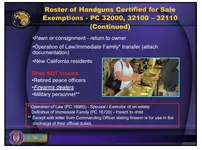
I'm going to point out, again, CA DOJ's official stance is that service members aren't (generally) exempt from the roster. I'm arguing that they probably
should be based off the statute, though there's some ambiguitity. So this theoretical until someone does a lawsuit.... or perhaps an underground regulation petition.
We debated this one a few years back on the "other forum." I don't know of any case law that settles the issue but there were two "take away" points from the discussion:
1) Individual military members have no authority to make purchases on behalf of the military. That requires an authorization from the military.
2) The term "sworn member" must be read in context. It can be easily argued that every military member swears an oath upon enlistment, commissioning, or accepting a warrant. But the context of the usage in the statute is that the intention is to cover members having Law Enforcement duties. An additional contextual issue is that the subparagraph containing the language discusses use in the performance of duties as the reason for allowing the purchase. Does any branch of the service permit the carrying of personal weapons in the performance of duty?
The issue is 32000(b)(4) has two functioning parts within paragraph 4. While it reads as so:
(b) This section shall not apply to any of the following:
...
(4) The sale or purchase of a handgun, if the handgun is sold to, or purchased by, the Department of Justice, a police department, a sheriff’s official, a marshal’s office, the Department of Corrections and Rehabilitation, the Department of the California Highway Patrol, any district attorney’s office, any federal law enforcement agency, or the military or naval forces of this state or of the United States for use in the discharge of their official duties. This section does not prohibit the sale to, or purchase by, sworn members of these agencies of a handgun.
It functionally reads as:
(b) This section shall not apply to any of the following:
...
(4) The sale or purchase of a handgun, if the handgun is sold to, or purchased by, the Department of Justice, a police department, a sheriff’s official, a marshal’s office, the Department of Corrections and Rehabilitation, the Department of the California Highway Patrol, any district attorney’s office, any federal law enforcement agency, or the military or naval forces of this state or of the United States for use in the discharge of their official duties.
This section does not prohibit the sale to, or purchase by, sworn members of these agencies of a handgun.
These are two seperate clauses. The first clause gives an organization-level purchase exemption for firearms to be used in the discharge of their official duties. The second clause gives an individual exemption for sworn members of those agencies. This is why sworn LEOs continue to enjoy the ability to purchase off-roster handguns for their own personal use basically due that second clause.
This is also an older law before the 2010 penal code reorganization, so you have to go further back, which Justia is always reliable for previous versions of the penal code. Before the reorginization, which keeping in mind the reorginizing of the code is not supposed to change the meaning of the statute it moves and re-words. Back then it was under
CA PC 12125(b)(4); 2009 edition
(b) This section shall not apply to any of the following:
...
(4) The sale or purchase of any pistol, revolver or other firearm capable of being concealed upon the person, if the pistol, revolver, or other firearm is sold to, or purchased by, the Department of Justice, any police department, any sheriff's official, any marshal's office, the Youth and Adult Correctional Agency, the California Highway Patrol, any district attorney's office, or the military or naval forces of this state or of the United States for use in the discharge of their official duties. Nor shall anything in this section prohibit the sale to, or purchase by, sworn members of these agencies of any pistol, revolver, or other firearm capable of being concealed upon the person.
Which makes the seperation of those two clauses in paragraph 4 even more clear. "Youth and Adult Correctional Agency" was removed and "any federal law enforcement agency" was added in
SB-363 (2013), as well as changing the wording some.
The only thing that's questionable is what "sworn member" means. In which case I don't know you'd have to look back to the original law I imagine... which I haven't done. I think it does bring up what the author (and by extension the legislature that passed it) intended. It's a really good question because if "sworn member" only means "Law Enforcement Officers", did the author include all the branches of the US Military to specifically give
their law enforcement officers an exemption? It is a bit baffling.
I do notice though that CA DOJ never seems to have passed any regulations regarding this... which arguably the policies they've enacted without regulations may be ripe for challenge as an underground regulation, just like
Micah Stubbs did when they challegend CA DOJ's FFL03 requirement for COE applications.