18+ Content Warning

By clicking Enter, you confirm you are 18 years of age or older and agree to comply with all applicable local, state, and federal laws.

Notice: Any content or member activity - including anything you may buy, sell, transfer, or discuss - must comply with current and upcoming laws.

Members are encouraged to stay informed: California Firearm Laws: 2026 Outlook & 2025 Recap . Responsibility for compliance rests solely with the individual member.

caguns.net

Welcome to CAguns.net!
Join our growing community where you can ask questions, share knowledge, or browse our classifieds section.

Sign up for a free account today and unlock full access! Once registered, you can search, post, and take advantage of exclusive features unavailable to guests.

A note on why more of the site now requires an account: automated scrapers and AI systems have been crawling our forums and classifieds at a scale. Requiring sign-in for those sections is the most effective tool we have. It takes a minute to register, it's free, and it keeps what happens here between actual members.

New to California gun ownership or trying to keep up with the changing laws? Check out our sister site CA2A.com — free courses, plain-English legal updates, and step-by-step guides built for California owners.

Advanced features are available only to registered members. Register today!

  • 📢 Classifieds Update — Effective Monday, September 21

    Starting Monday, the free Classifieds ad limit will be lowered from 3 to 2 active ads.

    Verified accounts will keep their limit of 3. All other account limits stay the same.

    Existing ads are not affected and will remain up until they expire.

    Want to keep 3 listings and add features like removing comments and emojis? Upgrade/Verify your account

    More information here

Kingpin / Maglock and Locking Back Bolt

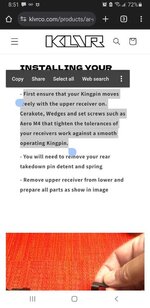
Um yea. Best of gunsmiths are always a student. Just because one has a gunsmith business can't shoot down other people's solution, especially when a manufacturer says something similar.

Mic drop.
 

Attachments

  • Screenshot_20241216-205130_Chrome.jpg
    Screenshot_20241216-205130_Chrome.jpg
    47 KB · Views: 14
Here are my thoughts on this magazine lock devices:

When the idea of the FIFY was floating around, the CA DOJ swiftly responded and made it clear that the FIFY device is NOT
LEGAL. Yet, they’ve stayed silent about devices like the AR Maglock and Hogue Freedom Fighter for, pretty much, 1/2 a decade. Although, there is no official “approval” by the CA DOJ for these products. The lack of response IS, to me, an indication that they don’t have a problem with these devices.

OR…it is just all a trap. And one day, a bunch of us will wake as felons, because of these devices on our rifles.
 
Here are my thoughts on this magazine lock devices:

When the idea of the FIFY was floating around, the CA DOJ swiftly responded and made it clear that the FIFY device is NOT
LEGAL. Yet, they’ve stayed silent about devices like the AR Maglock and Hogue Freedom Fighter for, pretty much, 1/2 a decade. Although, there is no official “approval” by the CA DOJ for these products. The lack of response IS, to me, an indication that they don’t have a problem with these devices.

OR…it is just all a trap. And one day, a bunch of us will wake as felons, because of these devices on our rifles.

My thoughts too, plenty of opportunity for them to say they're not compliant. This state loves killing small businesses.
 
They also have a section of their site that says "regulatory approvals" https://armaglock.com/regulatory-approval/ that seem to state this stuff was green lit by the state.
Nowhere on that page is there a greenlight from the state.
They reference the very same regulations concerning what "disassembly of the action" is that I referenced.
The legal description example includes REMOVAL of the takedown pin.
Have you ever seen anyone remove their sliding takedown pin to change mags?
I have not witnessed that.
It takes removal of the takedown pin AND opening the upper more than 1/2" at the back before the gun ceases to fire.
You can't open the upper from the lower anywhere near that far when the bolt carrier is sticking out of the upper receiver because the buffer tube captures the back end of the bolt carrier.

The main reason that this has not been a problem is simply that the BOF does not really know how the firearms or the compliance devices work well enough in order to actually say if they are legal or not.
The state is happy leaving it all legally in a gray area because most people comply with victimless-crime laws voluntarily.
 
Um yea. Best of gunsmiths are always a student. Just because one has a gunsmith business can't shoot down other people's solution, especially when a manufacturer says something similar.

Mic drop.
You clearly don't understand what I posted or what you posted as your mic drop.
Read the very FIRST sentence in your screengrab.

That is about the kingpin sliding in the lower.
The setscrews prohibit the kingpin from sliding freely because they tension the upper against the lower.
Setscrews are not in contact with the upper when the upper separates from the lower so they have no effect on the freedom of the kingpin sliding.
Nor do setscrews have any limitation on the OPENING distance between the upper and the lower.
The setscrew only limits the CLOSING distance.
 
Last edited:
This "tensioner" can make the king pin not separate the upper and lower at desired gap to get the king pin and maglock to not work properly.

Source: me.
Quoting to explain exactly what the above post is concerning.
 
So, the firing pin moves the rod in the barrel.

Does this mean the firing pin is actually striking the rod?

Possibly, is it moving from the jolt of the hammer slamming?

Or even if the firing pin is moving the rod, is it with enough force to cook off a round?

Or strike the primer in the right place instead of other locations on the casing?
 
So, the firing pin moves the rod in the barrel.

Does this mean the firing pin is actually striking the rod?

Possibly, is it moving from the jolt of the hammer slamming?

Or even if the firing pin is moving the rod, is it with enough force to cook off a round?

Or strike the primer in the right place instead of other locations on the casing?
The 3/16" brass rod weighing about 2.5 ounces jumped about 6" up when the firing pin hit it.
You won't notice the full 6" travel in the video because it happens too fast to capture in standard 30 frame video compressed for youtube playout.

That's absolutely enough to set off a primer.
It's the full energy that the firing pin gets every time you fire a round.

The hammer is quite a bit taller than is needed to strike the firing pin so that's why it will still fire when the receivers are 3/8" separated at the rear.
You can see how the hammer strikes the firing pin at 2:17 in this video:

The firing pin will never strike anywhere but the primer as the boltface holds the firing pin in the middle of the bolt and the barrel holds the cartridge and the bolt in the middle of the barrel.
My demo video is using a brass rod to SHOW that the firing pin is getting hit by the hammer.
The fact that the rod jumps up 6" is proof of this.
The gun does not "jolt" from the hammer striking the firing pin.
The gun sits perfectly still on the counter while I pulled the trigger making the video.

I could do a much better video of the brass rod jumping if I had a helper to hold the camera but I did the simple demo video by myself.
 
Last edited:
The 3/16" brass rod weighing about 2.5 ounces jumped about 6" up when the firing pin hit it.
You won't notice the full 6" travel in the video because it happens too fast to capture in standard 30 frame video compressed for youtube playout.

That's absolutely enough to set off a primer.
It's the full energy that the firing pin gets every time you fire a round.

The hammer is quite a bit taller than is needed to strike the firing pin so that's why it will still fire when the receivers are 3/8" separated at the rear.
You can see how the hammer strikes the firing pin at 2:17 in this video:

The firing pin will never strike anywhere but the primer as the boltface holds the firing pin in the middle of the bolt and the barrel holds the cartridge and the bolt in the middle of the barrel.
My demo video is using a brass rod to SHOW that the firing pin is getting hit by the hammer.
The fact that the rod jumps up 6" is proof of this.
The gun does not "jolt" from the hammer striking the firing pin.
The gun sits perfectly still on the counter while I pulled the trigger making the video.

I could do a much better video of the brass rod jumping if I had a helper to hold the camera but I did the simple demo video by myself.


Why do all that? Just chamber a primed casing and attempt to fire it. That’ll settle it completely if there is enough forcing hitting the firing pin to cause a round to fire.

If it sets off the primer, the weapon is not “disassembled”.

If it doesn’t, the weapon is “disassembled”.
 
Why do all that? Just chamber a primed casing and attempt to fire it. That’ll settle it completely if there is enough forcing hitting the firing pin to cause a round to fire.

If it sets off the primer, the weapon is not “disassembled”.

If it doesn’t, the weapon is “disassembled”.
Too noisy in a residence but I mentioned doing exactly that above as a valid test.
 
@AR15barrels, apologies for resurrecting a dead thread, but this topic of disassembly of the action has been on my mind. I'm having trouble squaring the Hogue FF+JT takedown pin with your statement:
None of the "break the action open" rear pins that let you "break the action open" without physically removing the rear pin actually cause the upper and lower to separate enough that the hammer will not reach the firing pin.
Does the Hogue FF + JT pin not operate in the same manner?
 
Last edited:
@AR15barrels, apologies for resurrecting a dead thread, but this topic of disassembly of the action has been on my mind. I'm having trouble squaring your earlier recommendation of using a Hogue FF+JT takedown pin with your later statement:

Does the Hogue FF + JT pin not operate in the same manner?

Yes.
 
Here’s my reasoning.

Let’s say it takes 1/8th of an inch for the receiver to open in order for the bolt not lock to the rear. 1/8th of an inch is “disassembled” and ok drop the magazine.

If you can open it 1/16th of an inch and lock the bolt the rear, the weapon is not disassembled and not ok to drop the magazine. If your rifle is capable of dropping the magazine (with let’s say the ar mag lock) that’s been filed down to 1/16th of an inch (so you can drop the magazine with the bolt locked to the rear) that means your rifle is capable of dropping a magazine when the rifle is not disassembled per state definition (it can still operate at 1/16th of an inch).

The hammer also has a cut out that prevents it from hitting the firing pin unless the action is closed, I am unsure what the tolerances are for that, but I bet if the bolt is capable of being locked and unlocked to the rear when the receiver is “open”, I’m guessing it can fire too.
Thanks for explaining this. For people like me who are new to this it’s like walking into a mine field.

I see the point people are making: it’s not how I choose to safely use my firearm. It’s how someone can manipulate my firearm to verify compliance. If I open the action just enough to drop a magazine, I should not be able to hold the bolt back. I hope I got that right.

Using a kingpin I can’t open the action and then hold the bolt back. I’m relying on the pivot pin and weight of the gun to open the action. I think I need to open the action just enough to be able to drop a magazine and then test if I can hold the bolt back.
 
Back
Top Bottom