18+ Content Warning

By clicking Enter, you confirm you are 18 years of age or older and agree to comply with all applicable local, state, and federal laws.

Notice: Any content or member activity - including anything you may buy, sell, transfer, or discuss - must comply with current and upcoming laws.

Members are encouraged to stay informed: California Firearm Laws: 2026 Outlook & 2025 Recap . Responsibility for compliance rests solely with the individual member.

caguns.net

Welcome to CAguns.net!
Join our growing community where you can ask questions, share knowledge, or browse our classifieds section.

Sign up for a free account today and unlock full access! Once registered, you can search, post, and take advantage of exclusive features unavailable to guests.

A note on why more of the site now requires an account: automated scrapers and AI systems have been crawling our forums and classifieds at a scale. Requiring sign-in for those sections is the most effective tool we have. It takes a minute to register, it's free, and it keeps what happens here between actual members.

New to California gun ownership or trying to keep up with the changing laws? Check out our sister site CA2A.com — free courses, plain-English legal updates, and step-by-step guides built for California owners.

Advanced features are available only to registered members. Register today!

  • 📢 Classifieds Update — Effective Monday, September 21

    Starting Monday, the free Classifieds ad limit will be lowered from 3 to 2 active ads.

    Verified accounts will keep their limit of 3. All other account limits stay the same.

    Existing ads are not affected and will remain up until they expire.

    Want to keep 3 listings and add features like removing comments and emojis? Upgrade/Verify your account

    More information here

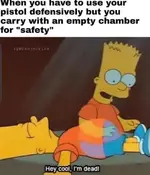
One in the chamber or no?

Why is that FUDD? You go slower until you build your muscle memory and smoothness, then you can start doing it faster. Just like motorcycle racing. You don’t start out fast you’ll just crash and die
Typically best practices from the competitive shooting side have agreed that in order to learn to shoot fast, you need to shoot fast. Not so fast/outside your comfort level that you’re hitting consistently only mikes, no shoots, or similar, but if you’re shooting 1-2 rounds a second at 10 yards static or something that’s not gonna to teach you how to process and shoot faster. You need to practice at an uncomfortable level, slightly above match pace to see how and where the wheels fall off in training.

So, continuing to shoot slowly and expecting that it translates well to when you’re shooting 4-5 times a second instead is usually flawed thinking.

Not to mention the habits you build and the fundamentals that might lead to acceptable results at closer distances (like 7-10 versus 15-25 yards), lower accuracy standards (just near center mass is different than head box or all A zone hits within a fist sized grouping), or at a slower pace change drastically/may not be serviceable anymore when the targets/shooter isn’t static, you’re having to transition between targets or at varying distances, etc. Once you speed up, make it more difficult through other factors or things like that every flaw is amplified - support hand grip that didn’t matter for single shot strings won’t work towards the end of the bill drill, shooting hand sympathetic movement might introduce unwanted input at speed, you might over or under return the gun, your index might be slightly off when presenting, you run into trigger freeze because you’re used to prep and pressing.

The list goes on and on.
 
Why is that FUDD? You go slower until you build your muscle memory and smoothness, then you can start doing it faster. Just like motorcycle racing. You don’t start out fast you’ll just crash and die

Too many people interpret that as “go slow."

I’d rather put it this way: “Be smooth. Smooth is fast. Slow is still slow.”
 
Typically best practices from the competitive shooting side have agreed that in order to learn to shoot fast, you need to shoot fast. Not so fast/outside your comfort level that you’re hitting consistently only mikes, no shoots, or similar, but if you’re shooting 1-2 rounds a second at 10 yards static or something that’s not gonna to teach you how to process and shoot faster. You need to practice at an uncomfortable level, slightly above match pace to see how and where the wheels fall off in training.

So, continuing to shoot slowly and expecting that it translates well to when you’re shooting 4-5 times a second instead is usually flawed thinking.

Not to mention the habits you build and the fundamentals that might lead to acceptable results at closer distances (like 7-10 versus 15-25 yards), lower accuracy standards (just near center mass is different than head box or all A zone hits within a fist sized grouping), or at a slower pace change drastically/may not be serviceable anymore when the targets/shooter isn’t static, you’re having to transition between targets or at varying distances, etc. Once you speed up, make it more difficult through other factors or things like that every flaw is amplified - support hand grip that didn’t matter for single shot strings won’t work towards the end of the bill drill, shooting hand sympathetic movement might introduce unwanted input at speed, you might over or under return the gun, your index might be slightly off when presenting, you run into trigger freeze because you’re used to prep and pressing.

The list goes on and on.
I’m not seeing how that contradicts what I said lol. You get the fundamentals down then add in speed and push your comfort zone. A lot less fear involved though
 
Too many people interpret that as “go slow."

I’d rather put it this way: “Be smooth. Smooth is fast. Slow is still slow.”
It’s an old boomer adage but “brake when you see god” really did work for me lol. And pushing yourself until you’re a little scared every lap until that’s the new normal
 
I’m not seeing how that contradicts what I said lol. You get the fundamentals down then add in speed and push your comfort zone. A lot less fear involved though
It's moreso that assumes that the shooter understands and is actively reinforcing the proper fundamentals at all times and in a way that will scale up or hold up when trying to shoot, fast, accurate, and aggressively.

A new shooter will not know what they don't know and if they're shooting as slow as it takes for them to get the end results they expect to see this usually means they prep and press the trigger, try to be surprised by the shot breaking, their stance only matters for that single shot, their grip isn't meant to hold up more than the single shot they're performing, they're staring at their sights instead of staying target focused. They're shooting in a way that leads to them getting the end result they want rather than realizing they're gaming the parameters to suit the end result they want to see and that you don't just flip a switch and scale up the same way. You have to shoot to a level of discomfort in difficulty, speed, etc.

Ok, so this new shooter does some or all of that to get the result they expect to see - a small grouping at like 7-10 yards shooting 1 shot at a time maybe 1-2 seconds between shots. They've ingrained these things into their muscle memory, what they associate with getting the outcome they expect and so when someone asks them to speed it up - maybe reactive doubles, a bill drill, or even just going out to 15 yards and shooting .5 splits the issues with their fundamentals start becoming apparent and likely compounding.

So, it's not necessarily that slowing down is always bad, but it's usually done by the uninformed and used as a stand-in or false notion that speeding up is just shooting slow but quicker. It's a potentially different skillset/environment - which is why it's important to train how you want to perform or need to perform (train how you fight) and also "practice doesn't make perfect. perfect practice makes perfect".

Joel and Ben are much better at articulating the nuances of this and have more experience with students as competition and LEO/SOF training instructors:


Why is that FUDD? You go slower until you build your muscle memory and smoothness, then you can start doing it faster. Just like motorcycle racing. You don’t start out fast you’ll just crash and die
Magoshands said “old fudd,” not FUD.

Fudd = Elmer Fudd (An old gun guy who thinks all you need is a shotgun, a bolt-action deer rifle, and maybe a revolver.)

IMG_2708.webp

FUD = Fear, Uncertainty, and Doubt (Also commonly known as fearmongering BS that people post in internet forums and that other people then start parroting in other threads and on other forums.)

IMG_2709.webp
 
It's moreso that assumes that the shooter understands and is actively reinforcing the proper fundamentals at all times and in a way that will scale up or hold up when trying to shoot, fast, accurate, and aggressively.

A new shooter will not know what they don't know and if they're shooting as slow as it takes for them to get the end results they expect to see this usually means they prep and press the trigger, try to be surprised by the shot breaking, their stance only matters for that single shot, their grip isn't meant to hold up more than the single shot they're performing, they're staring at their sights instead of staying target focused. They're shooting in a way that leads to them getting the end result they want rather than realizing they're gaming the parameters to suit the end result they want to see and that you don't just flip a switch and scale up the same way. You have to shoot to a level of discomfort in difficulty, speed, etc.

Ok, so this new shooter does some or all of that to get the result they expect to see - a small grouping at like 7-10 yards shooting 1 shot at a time maybe 1-2 seconds between shots. They've ingrained these things into their muscle memory, what they associate with getting the outcome they expect and so when someone asks them to speed it up - maybe reactive doubles, a bill drill, or even just going out to 15 yards and shooting .5 splits the issues with their fundamentals start becoming apparent and likely compounding.

So, it's not necessarily that slowing down is always bad, but it's usually done by the uninformed and used as a stand-in or false notion that speeding up is just shooting slow but quicker. It's a potentially different skillset/environment - which is why it's important to train how you want to perform or need to perform (train how you fight) and also "practice doesn't make perfect. perfect practice makes perfect".

Joel and Ben are much better at articulating the nuances of this and have more experience with students as competition and LEO/SOF training instructors:


I guess that's similar to pushing your limit and then crashing. Although some guys are just going to have it. Like my old teammate/best friend, racing since he was 4 - he always tells me "just go faster" lmao. So I guess just shoot faster
 
My father is a retired police detective and when he started carrying semiautomatic pistols he stated he never carried with one in the chamber due to accidental discharge. The training he did allowed him to rack one in seconds. I stated I personally carry one in the chamber due to being in a self defense situation I may not have time or a malfunction happening when I try to put a round in the chamber. Why chance that? Secondly if I invest in a good holster the odds of an accidental discharge due to my negligence is slim to none. What do you think? One in the chamber or no?
I mean no offense but if you can not / do not / will not carry with one in the chamber, you have ZERO business being around - let alone carrying - firearms.
You clearly do not have a high enough level of comfort, respect, training, nor knowledge of how firearms work.
Period.
Full stop.
End of story.

I don’t care if you are a Navy SEAL, active or retired LEO, retired military, or John Wick; any reason / justification given for not carrying with one in the chamber is an enormous red flag that you have no business being around / carrying firearms.

Let the flames begin….. 🙄

I am being dead serious and not trying to rage bait. It’s just the facts.

ETA:
Anyone who wants to debate this; go watch videos. Go see for yourself what actual, real life, caught on video self defense situations look like.
A huge, undeniable chunk of the time, they go from zero to “💩 I NEED MY GUN” in a fraction of a second, literally.

We are fortunate that there are SO many actual, real life videos out there of just about every situation imaginable. Spend time on YouTube / Rumble and see for yourself.

I again repeat; carrying with an empty chamber is an entirely unsupportable stance and it doesn’t matter what “experience” you have; you are just wrong.

I’d ask anyone who insists on carrying with an empty chamber if they do the same with revolvers; do you download by 1?

Do you ensure the chamber immediately under the hammer is empty, or the second chamber in line, so that if you were to negligently pull the trigger, the hammer would fall onto an empty chamber?

Better yet; put a snap cap or two in there. 🙄🙄🙄
Can’t be too careful, right? 🙄😑
 
Last edited:
my votes go to adding:

- "slow is smooth, smooth is fast"
- "slow down and get your hits"
- "I carry .45 ACP and 10mm because of their stopping power"

Are you debating these? Are you arguing these are untrue?

Because #1 & 2 are similar but absolute fact.

As for #3:

The first time I ever shot steel swinging targets with 9mm vs. .45 was mind-blowing.

The 9mm didn’t move the steel plate. Literally.

The .45 made that same target whip around fully to the other side as if it had been hit by a literal sledgehammer.

I’m not going to bag on anyone for choosing 9mm; it’s decent; but I’ve long since decided on .45, and shooting steel with it was all the proof I needed that I’d absolutely made the right choice.
 
That was drilled into me taking my hunters safety course back in 78 along with what the Army also taught me about weapons handling.
Who taught you?

You can’t hold up an HSC as any sort of meaningful, authoritative training. :ROFLMAO:

As for the Army;
A) Thanks for your service 🫡

B) was the Army talking about pistols or rifles?

Now, for rifles, you can make a case for storing a rifle unchambered, but if you are carrying it…. Should usually be chambered.
 
Are you debating these? Are you arguing these are untrue?

Because #1 & 2 are similar but absolute fact.

As for #3:

The first time I ever shot steel swinging targets with 9mm vs. .45 was mind-blowing.

The 9mm didn’t move the steel plate. Literally.

The .45 made that same target whip around fully to the other side as if it had been hit by a literal sledgehammer.

I’m not going to bag on anyone for choosing 9mm; it’s decent; but I’ve long since decided on .45, and shooting steel with it was all the proof I needed that I’d absolutely made the right choice.

Not really debating/saying they're untrue necessarily, moreso they're used as a stand in/fuddlore for a lack of training or awareness that in order to effectively shoot fast and accurately (like in a competitive or potential defensive situation) you need to practice shooting fast and accurately. You can learn to shoot slow and "get your hits" but if you aren't pushing yourself outside your comfort zone you're not going to suddenly just speed up how you were shooting slowly, but more quickly and get the same results.

As you speed up and increase the difficulty of the shooting parameters such as increasing distance, increasing level of acceptable accuracy, decreasing viable hitboxes (partials, no shoots, headbox only, etc.), transitions between varying distances, sight confirmation levels, etc. any deficiencies in your fundamentals like insufficient support hand connection, not staying target focused, an imbalanced stance that you could get away with or didn't get diagnostic feedback on when shooting slowly and maybe 1 shot at a time or something similar will compound for a poor result at speed.

People often use those phrases and truly believe shooting fast is just shooting slow, but quicker. Which it isn't necessarily.

As for the defensive caliber debate - I won't presume to tell anyone else what they should or shouldn't carry.

I just know for me that based on the data I've seen, number of hits on target and shot placement in the shortest window are what wins out when speaking of common handgun calibers for defensive purposes. To me, that means 9mm is an efficient choice as it has the most testing from a sample size and adoption standpoint across various testing mediums and in real life scenarios for military, law enforcement, and regular civilian use. It also gives me significantly more capacity per magazine than .45 acp or 10mm, is slightly easier to shoot, tends to have the most up to date technology in terms of updates to ammunition like bullet design or low flash powder aspects, and is cheaper, easier to source/stockpile, and is cross compatible with the other guns I spend 80-90% of my time training with for competition.

It just makes sense in my personal situation and probably for many others to take advantage of all of that, but I'm sure there are those that are well trained that would argue for their preferred caliber. I just rarely tend to meet that cross section of folks. Again, this is in the context of typical civilian self defense situations and not something like land management and large wildlife or something similar to that.
 
You clearly do not have a high enough level of comfort, respect, training, nor knowledge of how firearms work.
Period.
Full stop.
End of story.
I mean no disrespect DrJones, but a definitive comment like "you have ZERO business being around firearms", just is not true. We are free to choose what works for us AND we understand that tradeoffs.
 
Last edited:
I throw the gun at them because technically there getting hit by all 11 rounds instantly sending them to the forever box.
 
I love how “no offense” magically diffuses statements which basically paraphrase to “ you’re too much of a cowardly ignorant 🐱 to stand near a firearm… respectfully.. yours truly”.
 
I mean no disrespect DrJones, but a definitive comment like "you have ZERO business being around firearms", just is not true. We are free to choose what works for us AND we understand that tradeoffs.
It’s my opinion - based on decades of experience, research, and thinking, that you have no business being around firearms if one in the chamber terrifies you.
You are certainly free to do as you choose, and I’m free to have an opinion about it.
:)
 
Not really debating/saying they're untrue necessarily, moreso they're used as a stand in/fuddlore for a lack of training or awareness that in order to effectively shoot fast and accurately (like in a competitive or potential defensive situation) you need to practice shooting fast and accurately. You can learn to shoot slow and "get your hits" but if you aren't pushing yourself outside your comfort zone you're not going to suddenly just speed up how you were shooting slowly, but more quickly and get the same results.

As you speed up and increase the difficulty of the shooting parameters such as increasing distance, increasing level of acceptable accuracy, decreasing viable hitboxes (partials, no shoots, headbox only, etc.), transitions between varying distances, sight confirmation levels, etc. any deficiencies in your fundamentals like insufficient support hand connection, not staying target focused, an imbalanced stance that you could get away with or didn't get diagnostic feedback on when shooting slowly and maybe 1 shot at a time or something similar will compound for a poor result at speed.

People often use those phrases and truly believe shooting fast is just shooting slow, but quicker. Which it isn't necessarily.

As for the defensive caliber debate - I won't presume to tell anyone else what they should or shouldn't carry.

I just know for me that based on the data I've seen, number of hits on target and shot placement in the shortest window are what wins out when speaking of common handgun calibers for defensive purposes. To me, that means 9mm is an efficient choice as it has the most testing from a sample size and adoption standpoint across various testing mediums and in real life scenarios for military, law enforcement, and regular civilian use. It also gives me significantly more capacity per magazine than .45 acp or 10mm, is slightly easier to shoot, tends to have the most up to date technology in terms of updates to ammunition like bullet design or low flash powder aspects, and is cheaper, easier to source/stockpile, and is cross compatible with the other guns I spend 80-90% of my time training with for competition.

It just makes sense in my personal situation and probably for many others to take advantage of all of that, but I'm sure there are those that are well trained that would argue for their preferred caliber. I just rarely tend to meet that cross section of folks. Again, this is in the context of typical civilian self defense situations and not something like land management and large wildlife or something similar to that.

Ah, gotcha. And yes; I certainly agree with virtually all of what you said. 🫡

"Slow is smooth & smooth is fast" does certainly NOT mean "never push yourself, never try to improve, be content with where you are."
:cool: Nor should it be construed as such.


As for defensive caliber;
I again agree completely. I personally made my choice (.45 and .40) based off of a wide variety of factors. I'm in no way telling anyone that their choice is bad / worse, or better....unless they're CCW'ing a carbine / rifle..... 😁 In which case that is objectively better than any pistol caliber. 🤣🤪

You are perfectly correct; shot placement & timing are generally the overriding factors.
There's somewhat of a convention wisdom statement that; A well placed .22 beats a .45 in the arm (or not on target at all)" or something like that.... you get the point; Shot placement does rule the day - generally.

And personally, I find .45 easier to shoot; more pleasant & not as snappy. :-) But recoil is very subjective.

Thanks for the friendly chat.
:cool:
 
Back
Top Bottom