

- Messages
- 319
We live in a clown world.It's crazy these people have power in our society

By clicking Enter, you confirm you are 18 years of age or older and agree to comply with all applicable local, state, and federal laws.
Notice: Any content or member activity - including anything you may buy, sell, transfer, or discuss - must comply with current and upcoming laws.
Members are encouraged to stay informed: California Firearm Laws: 2026 Outlook & 2025 Recap . Responsibility for compliance rests solely with the individual member.

We live in a clown world.It's crazy these people have power in our society

edit: hold on I need to photoshop a tire being plugged into an outlet
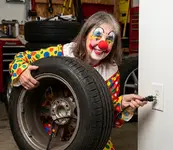

Well at least a clown state.We live in a clown world.
Fantastic! Another idea for this genius would be a tire like a crockpot on the kitchen counter connected by a power supply brick lolHere’s a picture of California Energy Commissioner Nancy Skinner. Will this do?
View attachment 239400

Whoops looks r/liberalgunowners found cagunsI mean you think they are out to get you, that the elections are rigged, that the EPA is a problem, but you can't actually identify or defend those positions because you don't even know why you think that except you feel like a victim. All you do is complain
I'm not a "liberal" but I do math and science for a living so I'm not a reactionary know nothing that has nothing to offer besides whining.Whoops looks r/liberalgunowners found caguns
Thats a lot of words to say "I did and will continue to vote for more government overreach into my life and everyone else's"I'm not a "liberal" but I do math and science for a living so I'm not a reactionary know nothing that has nothing to offer besides whining.
I have 3 cousins and an aunt who work for LA government and they absolutely get merit based raises for their performance.government employees don't get raises for performance but I don't disagree that it seems premature to jump straight to banning them. The EU has has efficiency regulations on tires for almost 20 years but they haven't banned them as far as I know. But all of the potential "negatives" that people list like longevity or traction don't bear out in the current LRR tires, they have 65k warranties and good traction ratings if they are made right. This has been a thing for a long time for big rig tires and those tires need to perform well and last a long time so I'm not sure if we need to worry about it. We will see.
Respectfully, I wouldn’t use LA government as a good example for anything..I have 3 cousins and an aunt who work for LA government and they absolutely get merit based raises for their performance.
LOL no argument from me there but that was only in response to the guy stating government employees don’t get raises based on performance.Respectfully, I wouldn’t use LA government as a good example for anything..
Fantastic! Another idea for this genius would be a tire like a crockpot on the kitchen counter connected by a power supply brick lol
Did anyone else notice this lady has the same tongue tendencies as Voldemort?
Bless her heart...

they don't in state government and government in general because it's all union. Unions don't get merit based raises you just get raises for existing, which is good and bad obviously. But if they work for the county they absolutely do not get "merit" based raises, it's all according to the pay schedule https://file.lacounty.gov/SDSInter/lac/1043266_alpha.pdfI have 3 cousins and an aunt who work for LA government and they absolutely get merit based raises for their performance.
What I don't understand is what do people think they will be missing? there are already LRR tires that have excellent life with 65K warranties, excellent performance in wet conditions, and will save you money on gas. Companies will just sell you whatever you will buy, so why shouldn't there be standards? As I have said in this thread over and over I'm playing devil's advocate because I don't have faith in anything and I haven't reviewed their data, but I can point to the national tractor trailer program that has already implemented these standards for years and it's not like we are seeing trucks crash everywhere because they don't work and can't grip the road. Consumers in general are pretty stupid honestly, just look at all the reactionaries in this thread who won't even read the rules but keep posting about how it does this or that. They have every opportunity to make a meaningful argument based in reality but instead choose to just talkThe comparison between the tire roster and the gun roster is the super duper obvious example, we have many fewer choices and the higher prices are the bonus! Why would tires be different? Further, how do some government regulators understand my needs and priorities better than I do?
My thought whenever regulators/busybodies/HOA Karen’s tell me what I can and can’t do is: I won’t pretend to know what you need better than you do.. why do you think you know my needs better than I do?
 . I should know better than to expect a thoughtful conversation here but I like to suffer

this is the well balanced and nuanced take I craveThe headline makes this sound more immediate and more sweeping than it actually is. I went through the regulation the CEC actually adopted on August 17.
The practical answer is: **nothing changes for you right now, motorcycles are exempt entirely, and the real effects on ordinary car owners do not begin until 2029. The part I'd watch is the much stricter 2033 standard, because that could reduce selection in some specialty/performance categories.**
The CEC formally adopted the rule 5-0 on August 17, but the resolution still directs staff to send the rulemaking package through the Office of Administrative Law process. So it has been approved by the Commission, but we're not waking up tomorrow to a new tire regime. ([California Energy Commission][1])
For your vehicles specifically:
* Your **Explorer, Tiguan and Golf** are within the general universe of passenger-car/light-truck replacement tires.
* Your **motorcycles are completely excluded**. The regulation expressly says a "replacement tire" does not include a motorcycle tire. So this has zero effect on your street motorcycle tires or motorcycle racing tires. ([California Energy Commission][2])
* Your existing tires are unaffected.
* Tires manufactured before the relevant implementation date aren't subject to the new energy requirement. The first phase applies to covered tires manufactured starting **January 1, 2029**. ([California Energy Commission][2])
The timeline is what really matters.
**2029–2032:** The ordinary passenger-tire rolling-resistance ceiling is 9.0 N/kN. The state itself estimates this phase will add about **$1.50 per tire/$6 per set**, while allegedly saving about $85 in fuel during the set's life. ([California Energy Commission][2])
**2033 onward:** The ordinary standard tightens substantially to **7.1 N/kN**. CEC estimates about **$6.50 extra per tire/$26 per set**, with roughly $179 in fuel savings over four years. ([California Energy Commission][2])
Those $6 and $26 figures are modeling estimates, though. They are **not price caps** and shouldn't be interpreted as "your tires will definitely cost only $26 more." SEMA specifically attacked that assumption, saying CEC didn't provide representative retail-price comparisons and warning that actual effects could include higher prices and fewer inexpensive choices. ([California Energy Commission][3])
Where the story got considerably less alarming is that CEC backed away from its earlier one-size-fits-all proposal after getting hammered by enthusiasts and the tire industry.
There are now broad exclusions for used and retread tires, dedicated winter tires, motorcycle tires, off-road recreational vehicle tires, limited-production tires, certain very-high-load tires, competition tires and certain large off-road tires. ([California Energy Commission][2])
And this one matters to people who actually care about performance tires: **ultra-high-performance street tires get their own substantially looser standard.**
A qualifying UHP tire can have rolling resistance as high as:
2029–2032: **9.8 N/kN**
2033+: **8.5 N/kN**
rather than the normal 9.0/7.1 limits. The UHP definition requires a W/Y-category high-speed tire with very strong wet braking performance. ([California Energy Commission][2])
So California isn't simply saying, "Michelin Pilot Sport-type tires are illegal because they grip too much." The regulation explicitly accommodates UHP tires.
Actual competition tires are excluded altogether if they satisfy the rule's definition: motorsports use, tread depth ≤8/32", W/Y/(Y) speed rating, UTQG ≤200 and not classified as all-season. ([California Energy Commission][2])
There is a legitimate wrinkle there. SEMA says that definition is still too narrow because some real drag, rally, autocross, endurance, track-day and other competition tires don't meet every one of those criteria. That means some niche motorsports products could still fall through the cracks. ([California Energy Commission][3])
For motorcycle racing, however, you don't care. The motorcycle exclusion occurs earlier in the definition and takes those tires outside this program completely.
There's also an interesting snow-tire carveout. Dedicated winter tires are excluded, while qualifying 3PMSF-style "all-season winter performance" tires remain technically in the program but have **no rolling-resistance requirement** and are exempted from the minimum wet-grip requirement. ([California Energy Commission][2])
That tells you something about the engineering reality here: even CEC recognized that maximizing snow performance can conflict with its efficiency thresholds.
As for the claim that this won't compromise handling or safety, there's more nuance than either side admits.
CEC tested 179 OE and replacement tire models and concluded that low rolling resistance doesn't inherently require poor wet grip, poor dry grip or shorter tread life. The adopted rule also creates a mandatory **minimum wet-braking index of 1.0** beginning with 2029-production tires, meaning California isn't simply ordering manufacturers to make hard, slippery eco-tires. ([California Energy Commission][1])
But the tire industry's response is not nonsense. USTMA explicitly said there are real engineering tradeoffs among rolling resistance, traction and tread life, particularly when you push toward the limits, and asked California to evaluate the first phase before imposing the tougher 2033 phase. CEC declined to put such a mandatory review into the final rule. ([California Energy Commission][4])
That's the part I think deserves scrutiny. Saying there is **no inherent correlation** is defensible; saying there are effectively **no engineering tradeoffs at all** would be overstating it. Tire design is famously a multi-variable optimization problem: compound hysteresis, carcass deformation, temperature range, tread depth, water evacuation, wear, steering response and rolling resistance all interact.
One other thing buried in the regulation is more consequential than the news coverage makes it sound: **you can't simply order a prohibited tire from Nevada or an out-of-state website.**
"Sold or offered for sale in California" expressly includes sales for California end use **regardless of where the seller is physically located**, including internet, telephone and mail-order transactions. ([California Energy Commission][2])
So starting with applicable 2029-production tires, Tire Rack or another online seller couldn't legally circumvent it just because the warehouse is outside California. In practice, sites will probably build California-compliance filters into their catalogs.
My assessment of the actual impact is therefore:
**2026–2028:** essentially zero.
**2029:** probably barely noticeable for ordinary drivers buying mainstream Michelin/Continental/Bridgestone/Goodyear/etc. tires. Some cheap or old tire designs disappear, manufacturers reformulate others, and prices may move slightly.
**2033:** this is where I expect a noticeable effect. Mainstream tires will still exist, obviously, but California may get a somewhat narrower SKU list, particularly among unusual sizes, specialized light-truck tires and performance products that don't fit one of the special categories. Manufacturers aren't going to redesign every slow-selling tire solely for California; they'll sometimes just stop selling that SKU here. USTMA specifically identified product withdrawal as a realistic manufacturer response. ([California Energy Commission][4])
So I wouldn't call this an automotive catastrophe. The final rule is **way less stupid than some of the earlier versions**, largely because the enthusiast/tire industry pushed hard enough to get motorcycle, competition, winter, UHP and off-road accommodations written in.
But it is still California telling you which replacement tires you're allowed to buy, and the state's rosy "$26 more per set" claim should be treated as a forecast rather than fact. The biggest legitimate concern isn't that all tires suddenly become dangerous eco-tires. It's **loss of consumer choice in marginal/niche categories once the 2033 standard arrives.**
For your particular garage, I would not change a single purchasing decision today because of this. Your motorcycles are untouched, and by the time the stricter automobile rules matter, the major tire manufacturers will have had years to redesign their mainstream lines.
This is one where a 2028/2032 check would actually be useful, because the tire catalogs will tell us much more than CEC's projections about the real-world impact.
[1]: https://efiling.energy.ca.gov/GetDocument.aspx?DocumentContentId=109720&tn=272046 "Resolution of Final EIR and Replacement Tire Efficiency Program"
[2]: https://efiling.energy.ca.gov/GetDocument.aspx?DocumentContentId=109074&tn=271526 "Notice of Additional Public Comment Period and Summary of Changes Replacement Tire Efficiency Program Rulemaking"
[3]: https://efiling.energy.ca.gov/GetDocument.aspx?DocumentContentId=109417&tn=271777 "Specialty Equipment Market Association Comments - Supplemental Comments on Revised Replacement Tire Efficiency Regulations Docket No 26-TIRE-01"
[4]: https://efiling.energy.ca.gov/GetDocument.aspx?DocumentContentId=109446&tn=271795 "US Tire Manufacturers Association Comments - Additional Comments "

None of these clowns are doing any of this for free I know that much.You are wrong. CA government also cares about power and control, often that comes with money, but it isn't just about money. They have an agenda and it isn't just about getting all the money that they can.
No valve disconnect!Will LE be exempt from the roster? Can a family member from out of state transfer me "off roster" tires? Do we think the secondary market will drive prices of existing tires up?
WTS: I have 4 like-new, pristine, off-roster Mashimoto ZX tires in fifth gen (EJ1) Honda Civic fitment. Have maybe 50 miles on them. Cleaned thoroughly after the one use. Very rare. $5,000. No lowballers, no offers, no trades. Not even body armor.